ARO-MSI and CGC Workshops in Computational Geometry
Dynamic geometric optimization.
D. Eppstein.
Invited talk,
3rd MSI Worksh. Computational Geometry, 1993, p. 14.
Choosing subsets with maximum weighted average.
D. Eppstein and
D. S. Hirschberg.
Tech. Rep. 95-12, ICS, UCI, 1995.
5th MSI Worksh. on Computational Geometry, 1995, pp. 7–8.
J. Algorithms 24: 177–193, 1997, doi:10.1006/jagm.1996.0849.
Uses geometric optimization techniques to find, among n weighted values, the k to drop so as to maximize the weighted average of the remaining values. The feasibility test for the corresponding decision problem involves k-sets in a dual line arrangement.
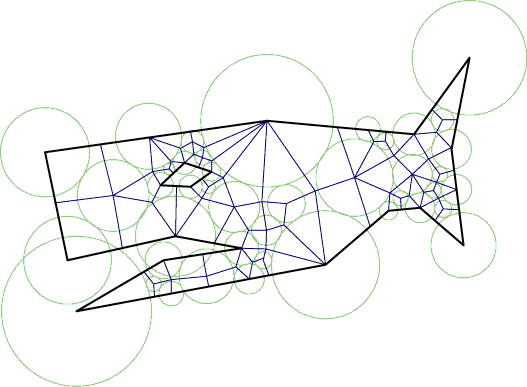
Quadrilateral meshing by circle packing.
M. Bern
and D. Eppstein.
2nd CGC
Worksh. Computational Geometry, Durham, North Carolina, 1997.
6th Int. Meshing Roundtable, Park
City, Utah, 1997, pp. 7–19.
arXiv:cs.CG/9908016.
Int. J. Comp. Geom. & Appl. 10 (4): 347–360, 2000,
doi:10.1142/S0218195900000206.
We use circle-packing methods to generate quadrilateral meshes for polygonal domains, with guaranteed bounds both on the quality and the number of elements. We show that these methods can generate meshes of several types:
The elements form the cells of a Voronoi diagram,
The elements each have two opposite 90 degree angles,
All elements are kites, or
All angles are at most 120 degrees.
In each case the total number of elements is \(O(n)\). The 120-degree bound is optimal; if a simply-connected region has all angles at least 120 degrees, any mesh of that region has a 120 degree angle.
Regression depth and center points.
N. Amenta,
M. Bern,
D. Eppstein, and
S.-H. Teng.
arXiv:cs.CG/9809037.
3rd CGC
Worksh. Computational Geometry, Brown Univ., 1998.
Disc. Comp. Geom. 23 (3): 305–323, 2000,
doi:10.1007/PL00009502.
We show that, for any set of \(n\) points in \(d\) dimensions, there exists a hyperplane with regression depth at least \(\lceil n/(d+1)\rceil\), as had been conjectured by Rousseeuw and Hubert. Dually, for any arrangement of \(n\) hyperplanes in \(d\) dimensions there exists a point that cannot escape to infinity without crossing at least \(\lceil n/(d+1)\rceil\) hyperplanes. We also apply our approach to related questions on the existence of partitions of the data into subsets such that a common plane has nonzero regression depth in each subset, and to the computational complexity of regression depth problems.
Ununfoldable polyhedra.
M. Bern,
E. Demaine,
D. Eppstein,
E. Kuo,
A. Mantler, and
J. Snoeyink.
arXiv:cs.CG/9908003.
Tech. rep.
CS-99-04, Univ. of Waterloo, Dept. of Computer Science, Aug. 1999.
11th Canad. Conf. Comp. Geom., 1999, paper 38.
4th CGC
Worksh. Computational Geometry, Johns Hopkins Univ., 1999.
Comp. Geom. Theory & Applications 24 (2): 51–62, 2003,
doi:10.1016/S0925-7721(02)00091-3 (special
issue for 4th CGC Worksh.).
We prove the existence of polyhedra in which all faces are convex, but which can not be cut along edges and folded flat.
Note variations in different versions: the CCCG one was only Bern, Demain, Eppstein, and Kuo, and the WCG one had the title "Ununfoldable polyhedra with triangular faces". The journal version uses the title "Ununfoldable polyhedra with convex faces" and the combined results from both conference versions. This became the first in a sequence of papers on ununfoldable polyhedra; see also "Ununfoldable polyhedra with 6 vertices or 6 faces" and "Acutely triangulated, stacked, and very ununfoldable polyhedra".