Mesh generation and optimal triangulation
The expected extremes in a Delaunay triangulation.
M. Bern,
D. Eppstein, and F. Yao.
18th Int. Coll. Automata, Languages and Programming,
Madrid, Spain, 1991.
Springer, Lecture Notes in Comp. Sci. 510, 1991, 674–685,
doi:10.1007/3-540-54233-7_173.
Int. J. Comp. Geom. & Appl.
1 (1): 79–92, 1991,
doi:10.1142/S0218195991000074.
Discusses the expected behavior of Delaunay triangulations for points chosen uniformly at random (without edge effects). The main result is that within a region containing \(n\) points, the expected maximum degree is \(O(\log n / \log\log n)\).
The farthest point Delaunay triangulation minimizes angles.
D. Eppstein.
Tech. Rep. 90-45, ICS, UCI, 1990.
Comp. Geom. Theory & Applications 1: 143–148, 1992, doi:10.1016/S0925-7721(98)00031-5.
Given a collection of points in convex position, the sharpest angle determined by any triple can be found as a corner of a triangle in the farthest point Delaunay triangulation.
Polynomial-size non-obtuse triangulation of polygons.
M. Bern
and D. Eppstein.
7th ACM Symp. Comp. Geom., North Conway, New Hampshire, 1991, pp. 342–350,
doi:10.1145/109648.109686
Int. J. Comp. Geom. & Appl. 2 (3): 241–255, 1992,
doi:10.1142/S0218195992000159
(special issue for 7th Symp. Comput. Geom.).
Erratum, Int. J. Comp. Geom. & Appl. 2 (4): 449–450, 1992,
doi:10.1142/S0218195992000305.
Any simple polygon can be triangulated with quadratically many nonobtuse triangles. Mostly subsumed by recent results of Bern et al described in "Faster circle packing".
Edge insertion for optimal triangulations.
M. Bern,
H. Edelsbrunner,
D. Eppstein,
S. Mitchell,
and
T.S. Tan.
1st Latin Amer. Symp. Theoretical Informatics, Sao Paulo, 1992.
Springer, Lecture Notes in Comp. Sci. 583, 1992, pp. 46–60,
doi:10.1007/BFb0023816.
Tech. Rep. EDC UILU-ENG-92-1702, Univ. Illinois, Urbana-Champaign, 1992.
Disc. & Comp. Geom. 10: 47–65, 1993,
doi:10.1007/BF02573962.
One standard way of constructing Delaunay triangulations is by iterated local improvement, in which each step flips the diagonal of some quadrilateral. For many other optimal triangulation problems, flipping is insufficient, but the problems can instead be solved by a more general local improvement step in which a new edge is added to the triangulation, cutting through several triangles, and the region it cuts through is retriangulated on both sides.
Provably good mesh generation.
M. Bern,
D. Eppstein, and
J. Gilbert.
31st IEEE Symp. Foundations of Comp. Sci.,
St. Louis, Missouri, 1990, pp. 231–241,
doi:10.1109/FSCS.1990.89542.
J. Comp. Sys. Sci. 48: 384–409, 1994,
doi:10.1016/S0022-0000(05)80059-5
(special issue for 31st FOCS).
In this paper, we construct triangulations of point sets and polygons by using quadtrees to add extra vertices to the input. As a result we can guarantee that all triangles have angles bounded away from zero, using a number of triangles within a constant of optimal; this was the first paper to provide simultaneous bounds on mesh element quality and mesh complexity of this form, and therefore the first to provide finite element mesh generation algorithms that guarantee both the robustness of the algorithm against unexpected input geometries and the quality of its output.
In the same paper we also use quadtrees to triangulate planar point sets so that all angles are non-obtuse, using linearly many triangles, and to triangulate higher dimensional point sets with no small solid angles and a number of simplices within a constant of optimal. Also, we can augment any higher dimensional point set so the Delaunay triangulation has linear complexity.
In later follow-up work, I showed that the same technique can also be used to find a triangulation whose edges have total length within a constant factor of optimal. Bern, Mitchell, and Ruppert showed that alternative methods can be used to triangulate any polygon without obtuse angles; see "Faster circle packing with application to nonobtuse triangulation" for an algorithmic improvement to their technique. Additionally, with Bern, Chew, and Ruppert, we showed that any point set in higher dimensions can be triangulated with nonobtuse simplices. Bern and I surveyed these and related results in our paper "Mesh generation and optimal triangulation".
Approximating the minimum weight Steiner triangulation.
D. Eppstein.
Tech. Rep. 91-55, ICS, UCI, 1991.
3rd ACM-SIAM Symp. Discrete Algorithms, Orlando, 1992, pp. 48–57.
Disc. Comp. Geom. 11: 163–191, 1994,
doi:10.1007/BF02574002.
Quadtree based triangulation gives a large but constant factor approximation to the minimum weight triangulation of a point set or convex polygon, allowing extra Steiner points to be added as vertices. Includes proofs of several bounds on triangulation weight relative to the minimum spanning tree or non-Steiner triangulation.
A conjecture from this paper, that for convex polygons the only points that need to be added are on the polygon boundary, turns out to be false. There is a counterexample in "Minimum-weight Steiner triangulation of convex polygons requires interior Steiner points".
Subquadtratic nonobtuse triangulation of convex polygons.
D. Eppstein.
Tech. Rep. 91-61, ICS, UCI, 1991.
This was merged into "triangulating polygons without large angles". We find a grid-like structure in the input polygon, which is then thinned out using a complicated divide-and-conquer scheme. The results are largely subsumed by the method of Bern et al. described in "Faster circle packing".
Triangulating polygons without large angles.
M. Bern,
D. Dobkin,
and D. Eppstein.
8th ACM Symp. Comp. Geom., Berlin, 1992, pp. 222–231,
doi:10.1145/142675.142722.
Int. J. Comp. Geom. & Appl. 5: 171–192, 1995,
doi:10.1142/S0218195995000106
(special issue for 8th Symp. Comput. Geom.)
Follows up "Polynomial size non-obtuse triangulation of polygons"; improves the number of triangles by relaxing the requirements on their angles. Again mostly subsumed by results of Bern et al described in "Faster circle packing".
Mesh generation and optimal triangulation.
M. Bern
and D. Eppstein.
Tech. Rep. CSL-92-1, Xerox PARC, 1992.
Computing in Euclidean Geometry,
D.-Z. Du and F.K. Hwang, eds.,
World Scientific, 1992, pp. 23–90.
Revised
version in Computing in Euclidean Geometry, 2nd ed.,
D.-Z. Du and F.K. Hwang, eds.,
World Scientific, 1995, pp. 47–123,
doi:10.1142/9789812831699_0003.
Considers both heuristics and theoretical algorithms for finding good triangulations and tetrahedralizations for surface interpolation and unstructured finite element meshes. Note that the online copy here omits the figures.
Algorithms for proximity problems in higher dimensions.
M. T. Dickerson and D. Eppstein.
Comp. Geom. Theory & Applications 5: 277–291, 1996,
doi:10.1016/0925-7721(95)00009-7.
Combines a method from "Provably good mesh generation" for finding sparse high-dimensional Delaunay triangulations, a method of Dickerson, Drysdale, and Sack ["Simple algorithms for enumerating interpoint distances", IJCGA 1992] for using Delaunay triangulations to search for nearest neighbors, and a method of Frederickson for speeding up tree-based searches. The results are fast algorithms for several proximity problems such as finding the k nearest neighbors to each point in a given point set.
(Local copy of CGTA 1996 version of "algorithms for proximity problems")
Faster circle packing with application to nonobtuse triangulation.
D. Eppstein.
Tech. Rep. 94-33, ICS, UCI 1994.
Int. J. Comp. Geom. & Appl. 7 (5): 485–491, 1997,
doi:10.1142/S0218195997000296.
Speeds up a triangulation algorithm of Bern et al. ["Linear-Size Nonobtuse Triangulation of Polygons"] by finding a collection of disjoint circles which connect up the holes in a non-simple polygon. The method is to use a minimum spanning tree to find a collection of overlapping circles, then shrink them one by one to reduce the number of overlaps, using Sleator and Tarjan's dynamic tree data structure to keep track of the connectivity of the shrunken circles.
Parallel construction of quadtrees and quality triangulations.
M. Bern,
D. Eppstein, and
S.-H. Teng.
3rd Worksh. Algorithms and Data
Structures, Montreal, 1993,
doi:10.1007/3-540-57155-8_247.
Springer, Lecture Notes in
Comp. Sci. 709, 1993, pp. 188–199.
Tech. Rep. 614, MIT Lab. for Comp. Sci., 1994.
Int. J. Comp. Geom. & Appl.
9 (6): 517–532, 1999,
doi:10.1142/S0218195999000303.
A parallelization of the quadtree constructions in "Provably good mesh generation", in an integer model of computation, based on a technique of sorting the input points using values formed by shuffling the binary representations of the coordinates. A side-effect is an efficient construction for the "fair split tree" hierarchical clustering method used by Callahan and Kosaraju for various nearest neighbor problems.
Dihedral bounds for mesh generation in high dimensions.
M. Bern,
L.P. Chew,
D. Eppstein, and
J. Ruppert.
892nd Meeting Amer. Math. Soc., Brooklyn, 1994.
Abstract in Abs. Amer. Math. Soc. 15, 1994, p. 366.
6th ACM-SIAM Symp. Discrete Algorithms,
San Francisco, 1995, pp. 189–196.
Any d-dimensional point set can be triangulated with O(nceil(d/2)) simplices, none of which has an obtuse dihedral angle. No bound depending only on n is possible if we require the maximum dihedral angle to measure at most 90-epsilon degrees or the minimum dihedral to measure at least epsilon. Includes a classification of simplices in terms of their bad angles.
Approximation algorithms for geometric problems.
M. Bern
and D. Eppstein.
Approximation Algorithms for \(\mathsf{NP}\)-hard Problems,
D. Hochbaum, ed.,
PWS Publishing, 1996, pp. 296–345.
Considers problems for which no polynomial-time exact algorithms are known, and concentrates on bounds for worst-case approximation ratios, especially those depending intrinsically on geometry rather than on more general graph theoretic or metric space formulations. Includes sections on the traveling salesman problem, Steiner trees, minimum weight triangulation, clustering, and separation problems.
Linear complexity hexahedral mesh generation.
D. Eppstein.
Tech. Rep. 95-51, ICS, UCI, 1995.
12th ACM Symp. Comp. Geom., Philadelphia,
1996, pp. 58–67,
doi:10.1145/237218.237237.
arXiv:cs.CG/9809109.
Comp. Geom. Theory & Applications 12: 3–16, 1999,
doi:10.1016/S0925-7721(98)00032-7
(special issue for 12th SCG).
Any simply connected polyhedron with an even number of quadrilateral sides can be partitioned into O(n) topological cubes, meeting face to face.
On triangulating three-dimensional polygons.
G. Barequet,
M. Dickerson,
and D. Eppstein.
12th ACM Symp. Comp. Geom., Philadelphia, 1996, pp. 38–47.
Comp. Geom. Theory & Applications 10: 155–170, 1998, doi:10.1016/S0925-7721(98)00005-4.
It is \(\mathsf{NP}\)-complete, given a simple polygon in 3-space, to find a triangulated simply-connected surface (without extra vertices) spanning that polygon. If extra vertices are allowed, or the surface may be curved, such a surface exists if and only if the polygon is unknotted; the complexity of testing knottedness remains open. Snoeyink has shown that exponentially many extra vertices may be required for a triangulated spanning disk.
Optimal point placement for mesh smoothing.
N. Amenta,
M. Bern,
and D. Eppstein.
8th ACM-SIAM Symp. Discrete
Algorithms, New Orleans, 1997, pp. 528–537.
Symp.
Computational Geometry Approaches to Mesh Generation,
SIAM 45th Anniversary Mtg., Stanford, 1997.
arXiv:cs.CG/9809081.
J. Algorithms 30: 302–322, 1999, doi:10.1006/jagm.1998.0984
(special issue for SODA 1997).
We study finite element mesh smoothing problems in which we move vertex locations to optimize the shapes of nearby triangles. Many such problems can be solved in linear time using generalized linear programming; we also give efficient algorithms for some non-LP-type mesh smoothing problems. One lemma may be of independent interest: the locus of points in Rd from which a d-1 dimensional convex set subtends a given solid angle is convex.
Quadrilateral meshing by circle packing.
M. Bern
and D. Eppstein.
2nd CGC
Worksh. Computational Geometry, Durham, North Carolina, 1997.
6th Int. Meshing Roundtable, Park
City, Utah, 1997, pp. 7–19.
arXiv:cs.CG/9908016.
Int. J. Comp. Geom. & Appl. 10 (4): 347–360, 2000,
doi:10.1142/S0218195900000206.
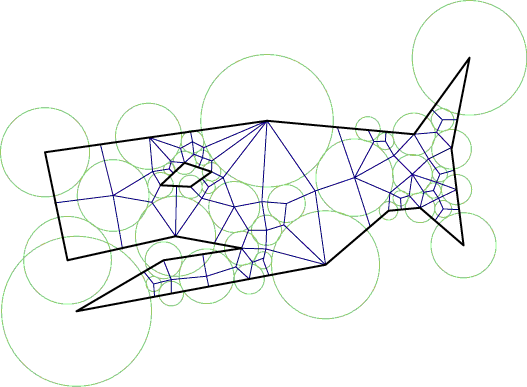
We use circle-packing methods to generate quadrilateral meshes for polygonal domains, with guaranteed bounds both on the quality and the number of elements. We show that these methods can generate meshes of several types:
The elements form the cells of a Voronoi diagram,
The elements each have two opposite 90 degree angles,
All elements are kites, or
All angles are at most 120 degrees.
In each case the total number of elements is \(O(n)\). The 120-degree bound is optimal; if a simply-connected region has all angles at least 120 degrees, any mesh of that region has a 120 degree angle.
Optimal Möbius transformations for information visualization
and meshing.
M. Bern
and D. Eppstein.
arXiv:cs.CG/0101006.
7th Worksh. Algorithms and Data
Structures, Providence, Rhode
Island, 2001.
Springer, Lecture
Notes in Comp. Sci. 2125, 2001, pp. 14–25, doi:10.1007/3-540-44634-6_3.
We give linear-time quasiconvex programming algorithms for finding a Möbius transformation of a set of spheres in a unit ball or on the surface of a unit sphere that maximizes the minimum size of a transformed sphere. We can also use similar methods to maximize the minimum distance among a set of pairs of input points. We apply these results to vertex separation and symmetry display in spherical graph drawing, viewpoint selection in hyperbolic browsing, and element size control in conformal structured mesh generation.
(WADS'01 Möbius proceedings version -- WADS'01 Möbius talk slides)
Topological issues in hexahedral meshing.
D. Eppstein.
Invited talk at
Conf. Algebraic
Topology Methods in Computer Science, Stanford, 2001.
We consider the problem of subdividing a polyhedral domain in R^3 into cuboids meeting face-to-face. For topological subdivisions (cell complexes in which each cell is combinatorially equivalent to a cube, but may not be embedded as a polyhedron) and simply-connected domains, a simple necessary and sufficient condition for the existence of a hexahedral mesh is known: a domain with quadrilateral faces can be meshed if and only if there is an even number of faces. However, conditions for the existence of polyhedral meshes remain open, as do the topological versions of the problem for more complicated domain topologies.
Flipping cubical meshes.
M. Bern
D. Eppstein, and
J. Erickson.
arXiv:cs.CG/0108020.
10th Int. Meshing Roundtable, Newport Beach, 2001, pp. 19–29.
Engineering with Computers 18 (3): 173–187, 2002,
doi:10.1007/s003660200016.
We examine flips in which a set of mesh cells connected in a similar pattern to a subset of faces of a cube or hypercube is replaced by cells in the pattern of the complementary subset. We show that certain flip types preserve geometric realizability of a mesh, and use this to study the question of whether every topologically meshable domain is geometrically meshable. We also study flip graph connectivity, and prove that the flip graph of quadrilateral meshes has exactly two connected components.
Note that the Meshing Roundtable version was by Bern and Eppstein. Erickson was added as a co-author during the revisions for the journal version.
Global optimization of mesh quality.
D. Eppstein.
Tutorial at
10th Int. Meshing Roundtable, Newport Beach, 2001.
Delaunay triangulation has been a staple of triangular mesh generation for a long time. Why? As well as being simple, fast, and visually pleasing, Delaunay triangulations can be shown to be optimal for various measures of mesh quality; for instance, they avoid sharp angles to the maximum extent possible. We review these and other results on construction of meshes that optimize given quality measures, including recent work on postprocessing tetrahedral meshes to eliminate slivers.
Tiling space and slabs with acute tetrahedra.
D. Eppstein,
J. M. Sullivan,
and A. Üngör.
arXiv:cs.CG/0302027.
Comp. Geom. Theory & Applications 27 (3): 237–255, 2004,
doi:10.1016/j.comgeo.2003.11.003.
We show it is possible to triangulate three-dimensional space using only tetrahedra with acute dihedral angles. We present several constructions to achieve this, including one in which all dihedral angles are less than 77.08 degrees, and another which tiles a slab in space.
Quasiconvex programming.
D. Eppstein.
Invited talk at DIMACS Worksh. on Geometric Optimization, New Brunswick,
NJ, 2003.
Plenary talk at ALGO 2004,
Bergen, Norway, 2004.
arXiv:cs.CG/0412046.
Combinatorial and Computational Geometry, Goodman, Pach, and
Welzl, eds., MSRI Publications 52, 2005, pp. 287–331.
Defines quasiconvex programming, a form of generalized linear programming in which one seeks the point minimizing the pointwise maximum of a collection of quasiconvex functions. Surveys algorithms for solving quasiconvex programs either numerically or via generalizations of the dual simplex method from linear programming, and describe varied applications of this geometric optimization technique in meshing, scientific computation, information visualization, automated algorithm analysis, and robust statistics.
(DIMACS'03 quasiconvex programming talk slides – ALGO talk slides)
Single-strip triangulation of manifolds with arbitrary topology.
D. Eppstein and
M. Gopi.
13th Video Review of
Computational Geometry, 2004.
20th ACM Symp. Comp. Geom., Brooklyn, 2004, pp. 455–456,
doi:10.1145/997817.997888
(abstract for video).
25th Conf. Eur. Assoc. for Computer Graphics (EuroGraphics '04),
Grenoble, 2004 (2nd best paper award).
Computer Graphics Forum 23 (3): 371–379, 2004,
doi:10.1111/j.1467-8659.2004.00768.x.
arXiv:cs.CG/0405036.
We describe a new algorithm, based on graph matching, for subdividing a triangle mesh (without boundary) so that it has a Hamiltonian cycle of triangles, and prove that this subdivision process increases the total number of triangles in the mesh by at most a factor of 3/2. We also prove lower bounds on the increase needed for meshes with and without boundary.
Single triangle strip and loop on manifolds with boundaries.
A. Bushan,
P. Diaz-Gutierrez,
D. Eppstein, and
M. Gopi.
Tech. Rep. 05-11, UC Irvine, School of Information and Computer Science,
2005.
Proc. 19th Brazilian Symp. Computer Graphics and Image Processing
(SIBGRAPI 2006), pp. 221–228,
doi:10.1109/SIBGRAPI.2006.41.
This follows on to our previous paper on using graph matching to cover a triangulated polyhedral model with a single triangle strip by extending the algorithms to models with boundaries. We provide two methods: one is based on using an algorithm for the Chinese Postman problem to find a small set of triangles to split in order to find a perfect matching in the dual mesh, while the other augments the model with virtual triangles to remove the boundaries and merges the strips formed by our previous algorithm on this augmented model. We implement the algorithms and report some preliminary experimental results.
Happy endings for flip graphs.
D. Eppstein.
arXiv:cs.CG/0610092.
23rd ACM Symp. Comp. Geom., Gyeongju, South Korea, 2007, pp. 92–101,
doi:10.1145/1247069.1247084.
J. Computational Geometry 1 (1): 3–28, 2010, doi:10.20382/jocg.v1i1a2.
We show that the triangulations of a finite point set form a flip graph that can be embedded isometrically into a hypercube, if and only if the point set has no empty convex pentagon. Point sets of this type include convex subsets of lattices, points on two lines, and several other infinite families. As a consequence, flip distance in such point sets can be computed efficiently.
Approximate Topological Matching of Quadrilateral Meshes.
D. Eppstein,
M. T. Goodrich,
E. Kim,
and R. Tamstorf.
Proc. IEEE
Int. Conf. Shape Modeling and Applications (SMI 2008), Stony Brook,
New York, pp. 83–92, doi:10.1109/SMI.2008.4547954.
The Visual Computer
25 (8): 771–783, 2009, doi:10.1007/s00371-009-0363-z.
We formalize problems of finding large approximately-matching regions of two related but not completely isomorphic quadrilateral meshes, show that these problems are \(\mathsf{NP}\)-complete, and describe a natural greedy heuristic that is guaranteed to find good matches when the mismatching parts of the meshes are small.
(Preprint)
Motorcycle graphs: canonical quad mesh partitioning.
D. Eppstein,
M. T. Goodrich,
E. Kim,
and R. Tamstorf.
Proc. 6th Symp. Geometry Processing, Copenhagen, Denmark, 2008.
Computer Graphics Forum 27 (5): 1477–1486, 2008, doi:10.1111/j.1467-8659.2008.01288.x.
We use a construction inspired by the motorcycle graphs previously used in straight skeleton construction, to partition quadrilateral meshes into a small number of structured submeshes. Our construction is canonical in that two copies of the same mesh will always be partitioned in the same way, and can be used to speed up graph isomorphism computations for geometric models in feature animation.
Diamond-kite meshes: adaptive quadrilateral meshing and orthogonal circle packing.
D. Eppstein.
arXiv:1207.5082.
21st International Meshing Round Table, San Jose, California,
2012, pp. 261–277, doi:10.1007/978-3-642-33573-0_16.
Engineering
with Computers 30 (2): 223–235 (special issue for the 21st
Int. Meshing Roundtable), 2014, doi:10.1007/s00366-013-0327-9.
We describe a recursive subdivision of the plane into quadrilaterals in the form of rhombi and kites with 60, 90, and 120 degree angles. The vertices of the resulting quadrilateral mesh form the centers of a set of circles that cross orthogonally for every two adjacent vertices, and it has many other properties that are important in finite element meshing.
Minimum-weight Steiner triangulation of convex polygons
requires interior Steiner points.
D. Eppstein and
Z. Hadizadeh.
arXiv:2606.25302.
Proc. 38th Canadian Conference on Computational Geometry, 2026,
to appear.
In "Approximating the minimum weight Steiner triangulation" I conjectured that the minimum weight Steiner triangulation of a convex polygon only needs its Steiner points to be on the boundary of the polygon. This would give the triangulation a tree-like structure that could potentially lead to an efficient dynamic programming algorithm for constructing it. Unfortunately, the conjecture is not true: we construct a counterexample.
(Blog post: A counterexample for Steiner triangulation – CCCG'26 steiner triangulation slides)